 Image 1 of 2
 Image 2 of 2
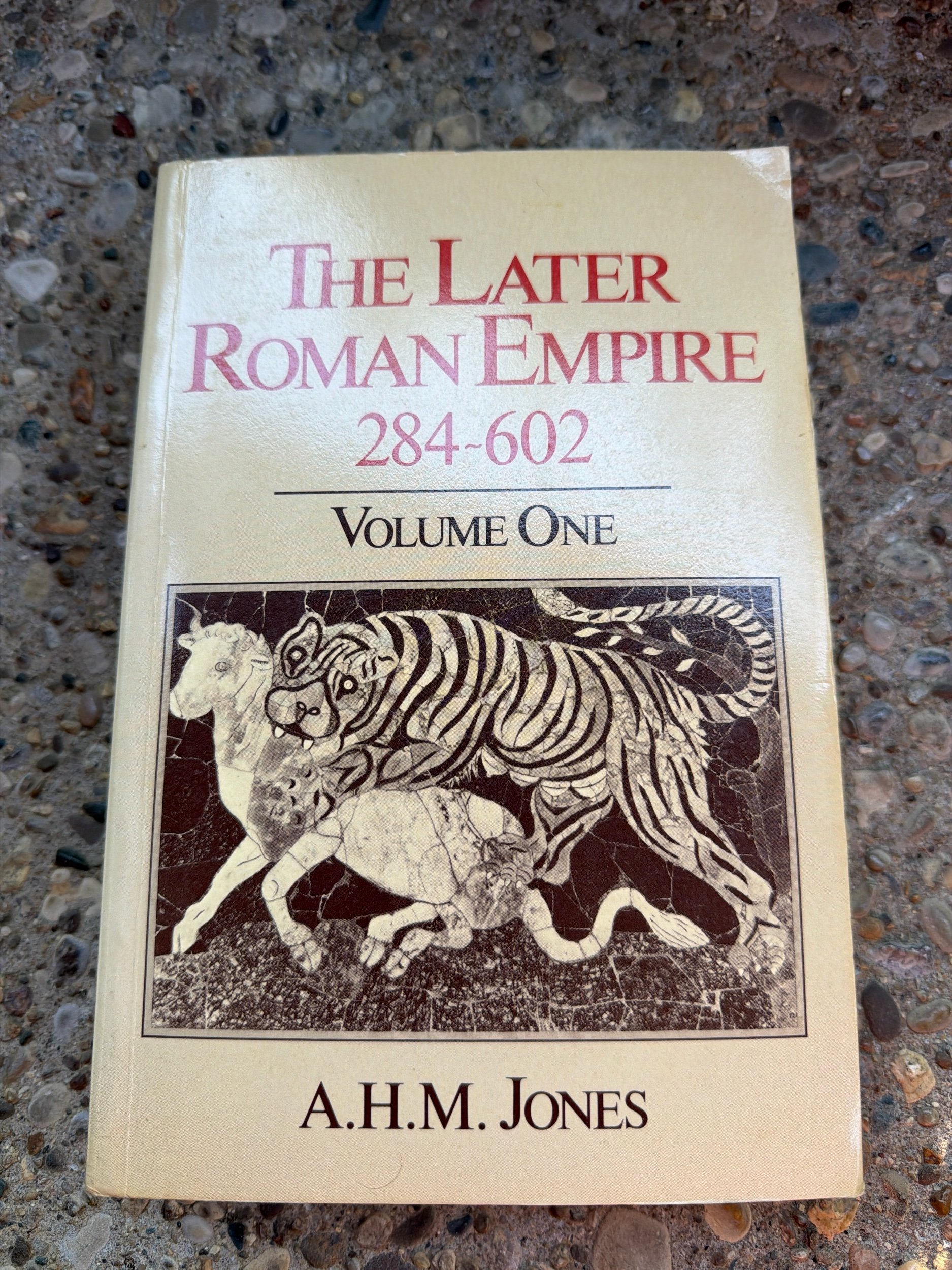
In this classic study of the Late Roman Empire, one of this century's most eminent ancient historians surveys social, economic, and administrative developments from the end of the Principate and the accession of Diocletian to the collapse of the empire in the West, a period encompassing the reigns of Constantine and Justinian, the establishment of a Christian imperial capital at Byzantium and the restoration of Roman rule in northern Africa.
The book presents a narrative account of Roman political, military, and religious history from 284 to 602. This overview precedes more detailed social, economic, and administrative history, where Jones turns to such specific topics as agriculture, education, imperial finance, structure and functions of government, and organization, recruitment, and conditions of service in the army. Throughout, he marshals evidence from the full range of surviving ancient documentary and literary source materials, including the legal codes, the lives of the saints, the Acts and Canons of the church, collections of letters, panegyrics, papyri, coins, and inscriptions. The notes and appendixes-consisting primarily of direct citation of the ancient sources-form a uniquely valuable compendium of evidence on the Late Empire.
*What Jones has done is to put together clearly and critically what was formerly scattered through a vast mass of often inaccessible source material and secondary literature.... He dominates his immense and recalcitrant material, solves its contradictions, assembles it so as to make an intelligible pattern. Every page bears the impress of a powerful mind.... It is a very different book from those of Gibbon and Bury. But on his own terms Jones is worthy to stand beside these giants. This book will be the starting point for all future work on the Late Empire for a very long time."-Robert Browning, Classical Review
"It is almost beyond belief that so much information should have been brought together in so readable a form by one man.... A masterpiece."-Economist
The late A. H. M. Jones was, from 1951 until his death in 1970, Professor of Ancient History at the University of Cambridge. He wrote more than a dozen books, many of them widely recognized as landmark studies.